
The Ohio Zone
An Altered State

“It is to be noted that a deserted street at four o’clock in the afternoon has as strong a significance as the swarming of a square at market or meeting times.”
― Henri Lefebvre, Rhythmanalysis: Space, Time and Everyday Life
The theorist Brian McCale passed away recently, and his passing got me thinking of Ohio. McHale, an English prof. at Ohio State University, co-founded Project Narrative; his 1987 book Postmodernist Fiction was a must-read text in Penn State’s English Department when I was there as a grad student in the late 80s and early 90s. In a section called “Ohio, Oz and other Zones” McHale describes how Ohio figures as a weird, postmodern zone that juxtaposes and superimposes the real and unreal:
The zone sometimes appears where we least expect it. In Ohio, for instance. In the literary and the popular imagination alike, Ohio has long maintained, as they say, a low profile. Its ‘image’ is one of colorlessness and poverty of associations. It is middle-American in every sense: middling in its landscapes and natural phenomena, culturally middling, sociologically middling—not, one would think, raw material for ontological improvisation. And yet . . . a number of postmodernist writers have chosen to improvise on the theme of Ohio.
There was something that rang deeply true in McHale’s words, a truth that got at the weird space of Ohio (not really a fly-over state, and yet . . .) and its wobbly geography (bordered by Kentucky and the sort-of-South on the one end and Michigan and the sort-of North on the other). My own family’s patch of northwest Ohio was the village of Waterville—around 15 miles downriver from Toledo—a tree-full, quiet town on the Maumee River surrounded by vast and open farms of soybean and corn. The Miami and Erie Canal (completed in 1845, the year Frederick Douglass published his narrative) had come through Waterville, and my first job—mowing lawns—was on Canal Street, though who cares about history like that when you’re a kid?
Ben Marcus set his 2002 novel Notable American Women in Ohio, complete with a section entitled “The Ohio Heartless” and lines like “It was a night of pure Ohio silence” and “Jane Marcus occurs in Deep Ohio.” In interviews, Marcus has said that he’s never been to Ohio and that he set the book there because he didn’t know anything about it, that “it was a blank slate for me.”
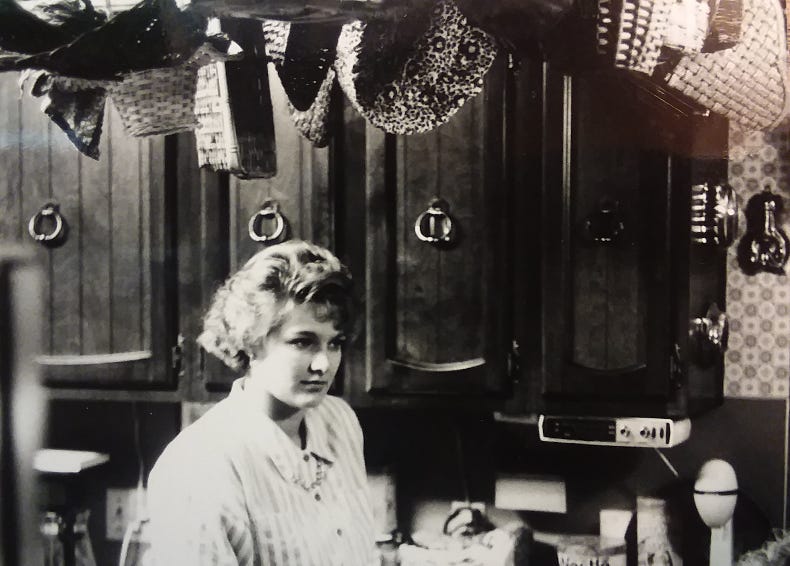
Maybe Ohio was a blank slate for those of us who lived there, as well. The baskets, for instance, woven from reed and wicker that hung from the rafters in my mother’s and in my Aunt Denise’s house, where Lisa is pictured in a photograph I made in 1984, the year before we were married, with my new Pentax 35 mm for the photojournalism class at Bowling Green taught by the diminished professor whose only feedback was black grease pencil Xs on our contact sheets of each each image he did not approve of, which often was all of them. I never understood the meaning of the baskets.
What of my Ohio in the 1970s and 80s? Yes, there were tuna casseroles baked with crushed potato chips on top. There was lime Jell-O with pink tip-of-thumb-sized marshmallows inside. Canned pears with a dollop of Hellmann’s mayonnaise with grated cheese on top. These were the accoutrements of our time and place. So were games of horseshoes at dusk in our backyard, the sweet clank from my grandfather’s ringers echoing out across the river. So was the slow black truck that rolled down our dark streets in July spraying for mosquitoes. The wide, heavy Pontiac Phoenix that sat in our gravel driveway whose drivers’ side door, on frigid winter mornings, we had to unfreeze by dousing it with a pan of boiling water.
There was no crime that I recall, at least not in the routes we circuited. We had no serial killers, no stranglers like out in California or Sons of Sam like in New York. We passed around a worn copy of the Manson murder book Helter Skelter (1974) with its weird happy yellow cover and Hanna-Barbera font.
The more we stared at that evil photo of Sharon Tate’s blood soaked into the shag rug the more we could feel our brains rotting. It felt good to look at these crime scene photos and we felt guilty that it made us feel good to look at them. But when the principle confiscated the book I was secretly relieved.
The Mansons: Is that what the hippies were like?
Were there hippies in Toledo?
For a while we confused Sharon Tate and Patti Hearst.
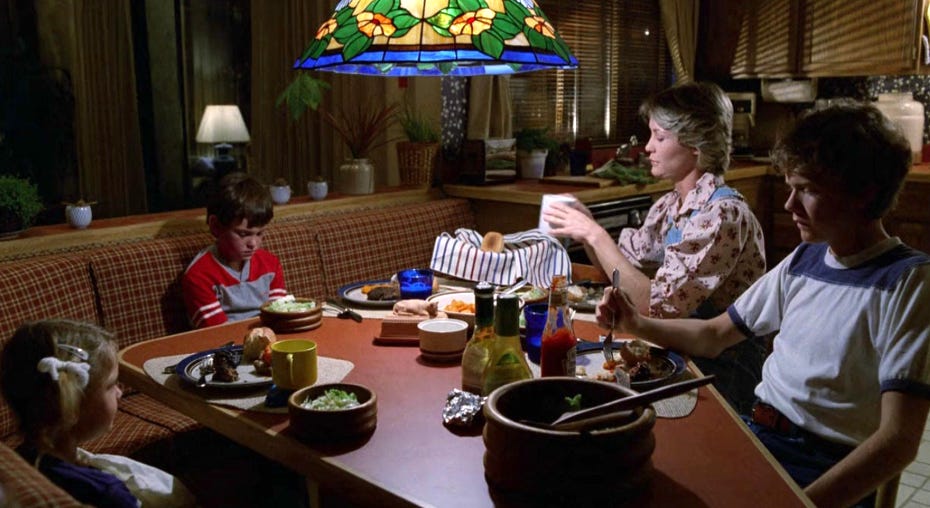
The only Hollywood movies I recall that got close to capturing the feeling of a familiar daily domestic life and home in northwest Ohio were Spielberg’s Close Encounters of the Third Kind (1977) and E.T. (1982). The wooden salad bowl, the bottles of dressing on the dinner table, the shifting, tired moods at the end of a day. But even that—with its airiness and soft light—felt a little more like I imagined California was than Ohio. Elliott—who has seen the E.T. creature and who nobody believes—calls his older brother “penis breath” in a fit of frustration, a scene invoked in Donnie Darko’s “you can go suck a fuck” line delivered by Maggie Gyllenhaal to Jake Gyllenhaal, siblings in the movie, as well.
Was Ohio something to be escaped from, or escaped deeper into as a sort of sheltering-in-place? In college in 1986 Lisa and I lived in a creaky rented house on a street named Buttonwood, the old name for the Sycamore tree. A tall, elderly man known simply as Titus lived on that street as well, a lone figure with a fedora, a buttoned-up-to-the neck white shirt and black suspenders who, with his hands behind his back, walked the neighborhood ceaselessly. When R.E.M.’s Fables of the Reconstruction came in the mail and wouldn’t hold the needle, which kept sliding across the vinyl, I asked our upstairs neighbors, Ken and Carol, if I could test it on their turntable.
They were grad students and seemed old before their age.
They were people intent on something, although I could never figure out what.
Ken sat on the couch and read the newspaper as if I wasn’t there while I put on side 2, “Can’t Get There from Here” which played just fine and which aroused no opinion from Ken one way or the other. Did he have something against R.E.M. and, by extension, me? One day Carol came to the door in a yellow smock and asked for two cups of flour, and then returned the exact same amount later that night, left beneath the porchlight in a plastic bag like, we joked, a shitload of cocaine. (We had no idea what a shitload of cocaine might look like.) In exchange for mowing the small lawn our rent was reduced from 190.00 to 170.00. Our landlord’s wife was jailed for a month for excessive DUI’s, a story reported in the Sentinel-Tribune and which caused, I think, a deep depression in our landlord.
I had a work study job a few streets over at WBGU-TV, where I sat at a machine against the brown brick wall, a machine that rewound and cleaned the 16mm educational films the station loaned, as part of its public service, to the rural elementary and middle schools that dotted northwest Ohio: Kentwood, Crim, Conneaut, Franklin, Waverly. The films came back always a little bit wrecked and sometimes a lot wrecked, as if they had been mis-threaded through underperforming film projectors by the dumb kids working AV.
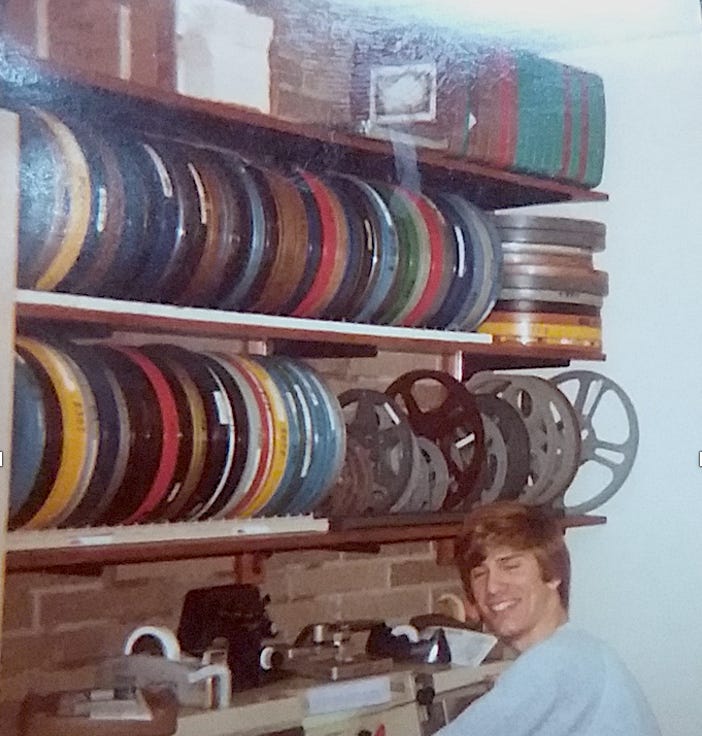
Rewinding them onto a new reel was really a two-for-one action, because during the rewind the film passed between two, small, eraser-like pads which wiped away chalk dust and smudges. I’d lose myself in the thought of the process, the machine humming, the deep drama of my mind maybe drifting to the metaphysical poets we were reading in English class: “Who would have thought my shriveled heart / Could have recovered greenness? It was gone / Quite underground.” George Herbert, calling across the centuries, knew the score.
Repairing the films involved cutting out portions where the sprockets had been torn, as many of the films were old and brittle. Warm Blooded and Cold Blooded Animals, from the early 1970s, was a favorite, always in demand. What about this educational film, I wondered, did the kids like? I’d use the splicer to tape together the two separated film portions, and with one firm push of the handle lay down the thick, clear, splicing tape, punching in a fresh set of sprocket holes. And each time I did this the film was diminished by a fraction. Made ever so shorter. A loss of 18 frames here, 12 frames there. I’d keep many of these spliced-away remainders, tacking them onto our cork board on Buttonwood or using them as bookmarks, those fragile, sprocket-torn strips. I was protective of them, these parts that I’d surgery-ed-out from the whole, the damaged snippets of film that the students would now never see. I was making jump cuts in the films before I knew what jump cuts were. Bit by bit, the films were being randomly trimmed and re-edited.
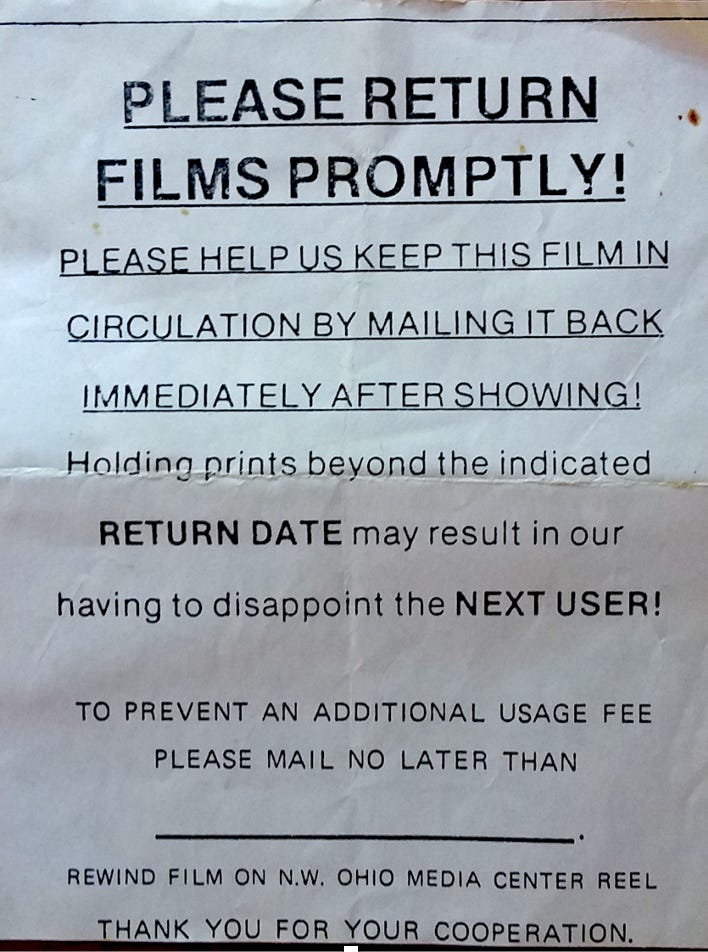
My supervisor, Doug, a staunch man from McClure, Ohio (a meth addict, it would turn out) with tight-fitting clothes and a receding face, reprimanded me one warm September afternoon because he’d discovered some poems I’d written on the backs of the small Please Return Films Promptly! slips that went back in the metal canister with each freshly repaired film. I loved that they were called prints (not copies) and the directness, the politeness of the line may result in our having to disappoint the NEXT USER!
When we moved to Penn State for grad school several years later this was something we noticed, the absence of that Midwestern, deferential politeness.
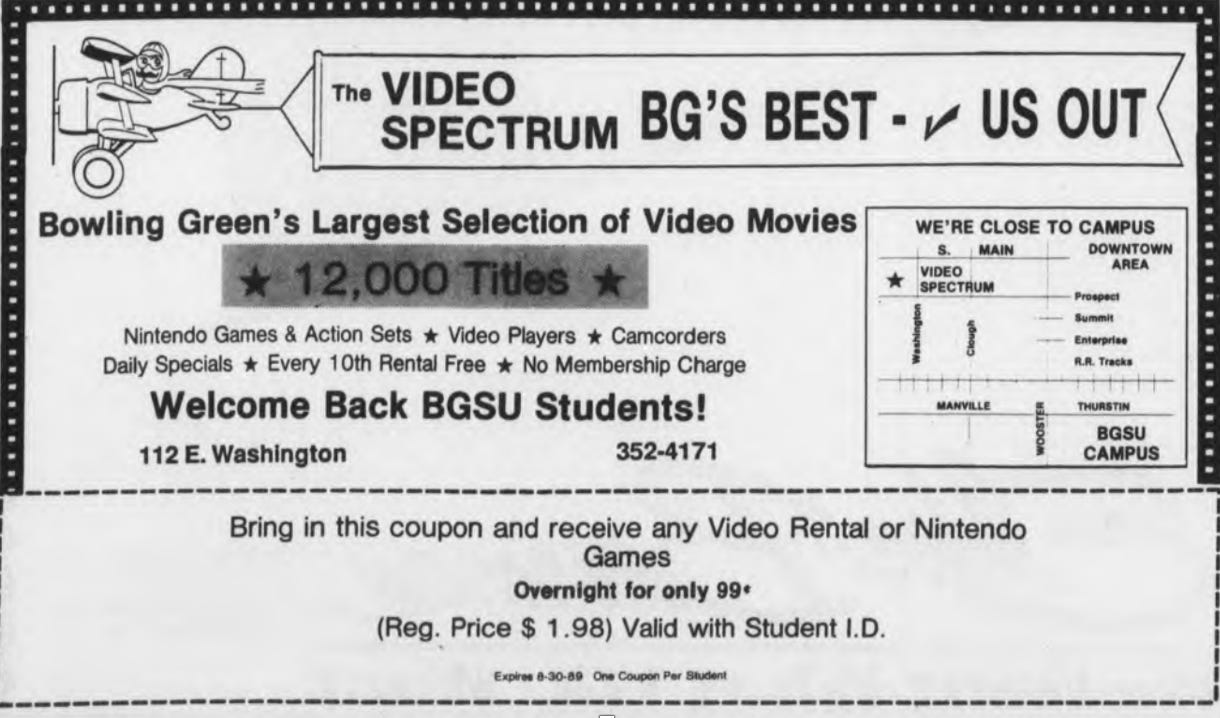
In the fall semester of 1987 Dr. Fricke, in our non-fiction creative writing class in Williams Hall, told us an anecdote about his bitter divorce, and in telling this would mention that he’d recently rented a film called Blue Velvet, the most remarkable thing he’d seen since Apocalypse Now. He probably rented it at Video Spectrum on Washington Street, a few blocks from our apartment, where they stamped your membership card with bright red lips for your free tenth rental.
Dr. Fricke’s anecdote involved a barn at night in Nebraska that he wandered into (I don’t remember how he got there) where he witnessed a cow in the act of its slaughtering and where, he said, he stood stunned as its heart was removed. I don’t know whether or not we believed him. In class he held up his arm and, shaking his fist gently as if he was holding his own heart there, said this is what my wife did to me, tore out my heart.
It was then, watching him, that I discovered that what I was learning wasn’t really about the books and movies we were studying but rather about how to think about them, what to say about them, what sorts of questions to ask about them. How to let them inhabit us, so that we, in turn, could inhabit them. This is how I came to live inside of Blue Velvet. Dr. Fricke spoke with what seemed like a fake, lightly German accent and left the University suddenly the next year. I didn’t think much about him until I became a professor myself and, years after mentioning Harmony Korine’s film Gummo in film class one afternoon a student wrote to tell me how watching that film set her down a path that led to her career as a video artist.
Through an assemblage of texts and references what Dr. Fricke was really teaching us was how to curate ourselves against sadness. I really believe that. I sometimes think of this during the grind of teaching during those inevitable patches of the semester when nothing seems to stick. When the vibe has gone. I shore myself up with this notion, perhaps just a fanciful notion, that for a few of my students, at least, I am, in the literature we are reading and discussing and the films we are watching, arming them with something to hold against the darkness.
Even though some of us in Dr. Fricke’s class couldn’t see it coming yet, it was there, sadness on the horizon and he mentioned Blue Velvet because, as he unlocked his way through it, it brought him hits of pleasure. Maybe that’s what interpretation was all about, and therefore what teaching was all about. The Interpretation of Dreams. Maybe that was Freud’s own therapy, the thing that brought him happiness: interpretation as therapy. In The Pleasure of the Text, Roland Barthes writes:
Text of bliss: the text that imposes a state of loss, the text that discomforts (perhaps to the point of a certain boredom), unsettles the reader’s historical, cultural, psychological assumptions, the consistency of his tastes, values, memories, brings to a crisis his relation with language.
I had also seen Altered States around that time, a film that had been released in 1980 to a limited viewership but which gained cult fame after its release on VHS in 1981. I dubbed it onto a blank VHS, which we bought in packages of three and there is such a sadness to see my father’s handwriting on the VHS tape in his distinctive slant. ALTERED STATES. He’d labelled it for me even though it wasn’t a film he liked, although we both were intrigued by the intensity of William Hurt and his particular vocal cadence and we both loved Body Heat. I remember around that time there was an article—maybe in Time, maybe picked up in the Toledo Blade—about a new breed of downbeat, nihilistic actor that referenced Body Heat and Blade Runner and those movies felt a little bit dangerous and corrupting, somehow.
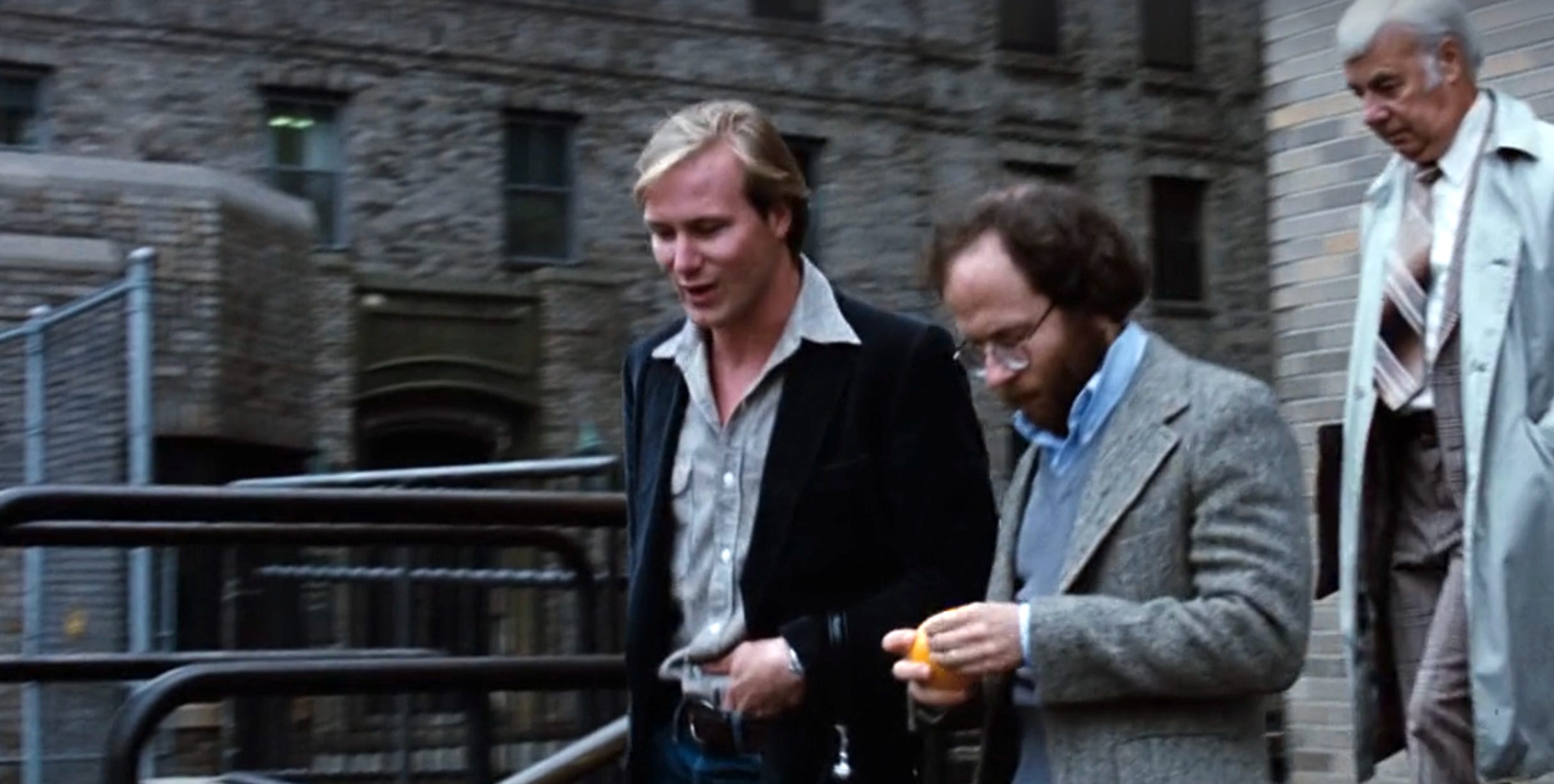
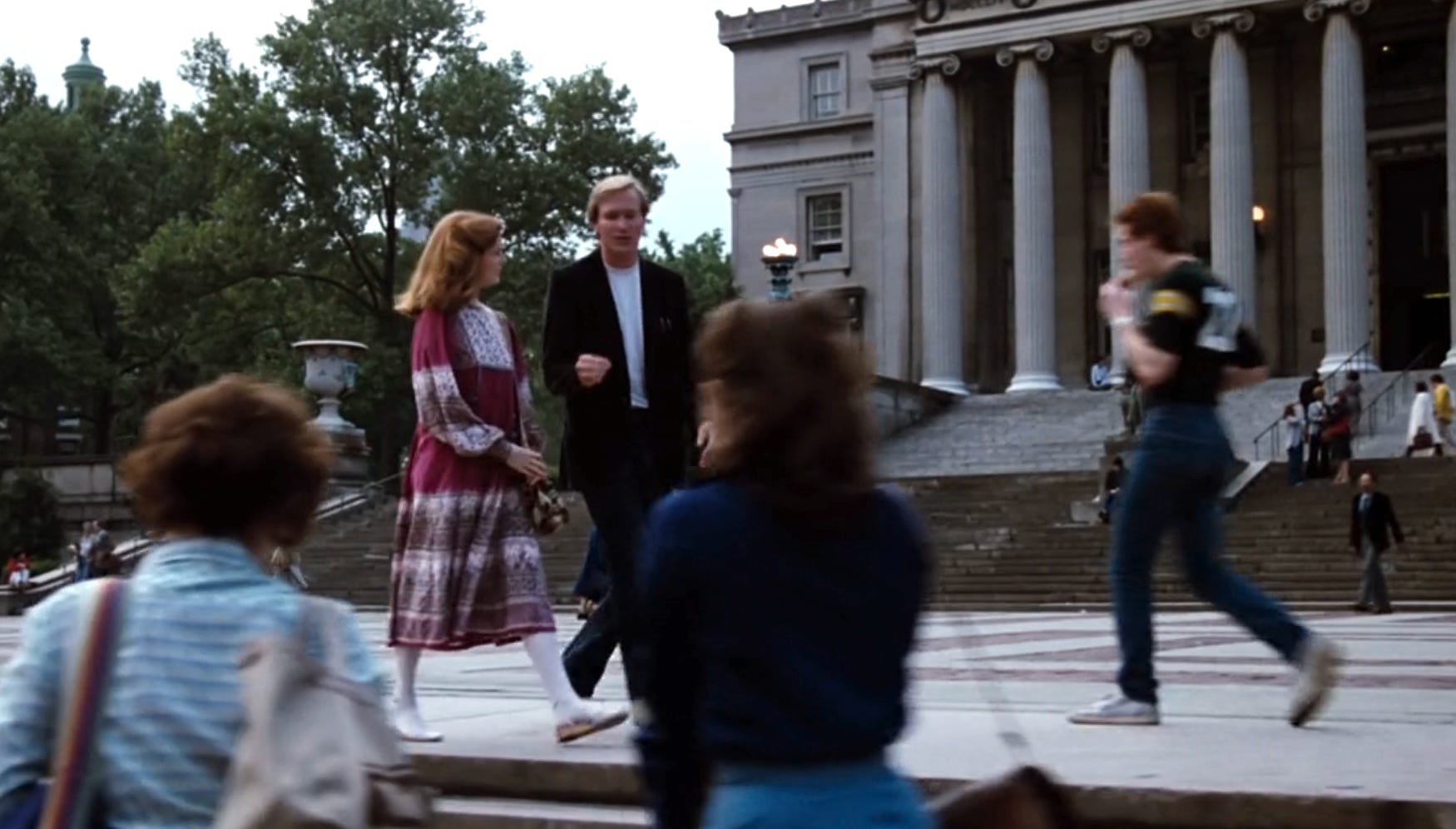
The VHS quality was so low and noisy and degraded that when I saw it again, for the first time on the big screen, at Bowling Green in 1987, I fell in love with it for different reasons: the effortless coolness of William Hurt’s professorial outfits as a Harvard professor and so, of course, I had to be one, I had to be that man: William Hurt as Dr. Edward Jessup, who actually dares to say, over a rambling dinner of pasta and wine:
I’m a man in search of his true self. How archetypically American can you get? Everybody’s looking for their true selves. We’re all trying to fulfill ourselves, understand ourselves, get in touch with ourselves, face the reality of ourselves, explore ourselves, understand ourselves. Ever since we dispensed with God, we’ve got nothing but ourselves to explain this meaningless horror of life.
I’d never seen a film that embraced critique like this, that so directly poked at American narcissism while at the same time glamorizing its narcissistic protagonist, but then this was a Paddy Chayefsky script. Between real professors like Dr. Fricke and movie professors like Dr. Jessup and even Michael Cain in Educating Rita I began to see myself as one of them, people working within the system but with the freedom to think dangerous thoughts, to say dangerous things, to push back and to critique.
I didn’t know the critical language of “theory” yet—that would come at Penn State—but I knew it in my bones and I was searching for it, the concepts and frameworks to help me stand outside the forces of culture that wanted me to purchase, to consume, to purchase more, to consume more, to be happy, to be happier, to be the happiest, to make and keep my wealth, to blame others for their own misfortunes, to embrace family values and to consume popular cultures—movies especially—that reinforced and, more radically still, actually helped create and then channel those values.
I also began to understand that it was often the little moments in movies—the throwaway lines, the accidental angles of sunlight, the pauses between words, the unexpected gust of wind in the trees—that stick with you and give you something to hang your hat on in terms of the small pleasures of this world.
How not to die. How not to kill yourself from sadness.
That’s what I learned from small pleasures, from listening to Dr. Fricke latch onto and talk excitedly about these small pleasures in Blue Velvet.
What did it mean to be successful, as a filmmaker, a writer, an artist, a teacher?
Was it the number of people your work touched or the strangeness of the way it touched just a few people?
How could Paddy Chayefsky or Ken Russell (Altered State’s director) or William Hurt or Ruth Myers (who did the costumes) ever know that Altered States planted a seed in my head that grew me into who I became as much as church or family did?
Or maybe I was altered before I was Altered, the movie simply giving shape on the screen to what I would become.
Thank you for your essay. I have ruminated on our state as well: https://open.substack.com/pub/docwanat/p/what-happened-in-ohio?r=22egl6&utm_campaign=post&utm_medium=web
Among the piercingly poignant moments...
"I’d keep many of these spliced-away remainders, tacking them onto our cork board on Buttonwood or using them as bookmarks, those fragile, sprocket-torn strips."
Punctum, all.