
Hypertext Fiction and AI

For a while, in the early-to-mid 1990s, hypertext fiction seemed poised to become a new form of storytelling. I happened to be in grad school at the time, and although my focus was early American literature, we were all pretty excited about the possibilities hypertext offered for innovative, choose-your-own adventure, associative style storytelling. What happened? In part, the ubiquity of hyperlinks (or, just links; i.e., the internet itself) overpowered everything, defanging the weirdness of experimental hypertext (links within a document/story rather than out into the web itself). There were all sorts of articles and think pieces about how hypertext fulfilled a radical storytelling potential only hinted at in works like Borges’s “The Garden of Forking Paths” and “The Library of Babel” (both 1941), with their implied multiple, perhaps infinite, narrative strands.
One of the most vocal and potent champions of hypertext wasn’t a theorist but a writer, Robert Coover, whose great and dramatic essay “The End of Books,” appeared in The New York Times in 1992:
The most radical new element that comes to the fore in hypertext is the system of multidirectional and often labyrinthine linkages we are invited or obliged to create. Indeed the creative imagination often becomes more preoccupied with linkage, routing and mapping than with statement or style, or with what we would call character or plot (two traditional narrative elements that are decidedly in jeopardy). We are always astonished to discover how much of the reading and writing experience occurs in the interstices and trajectories between text fragments. That is to say, the text fragments are like stepping stones, there for our safety, but the real current of the narratives runs between them.
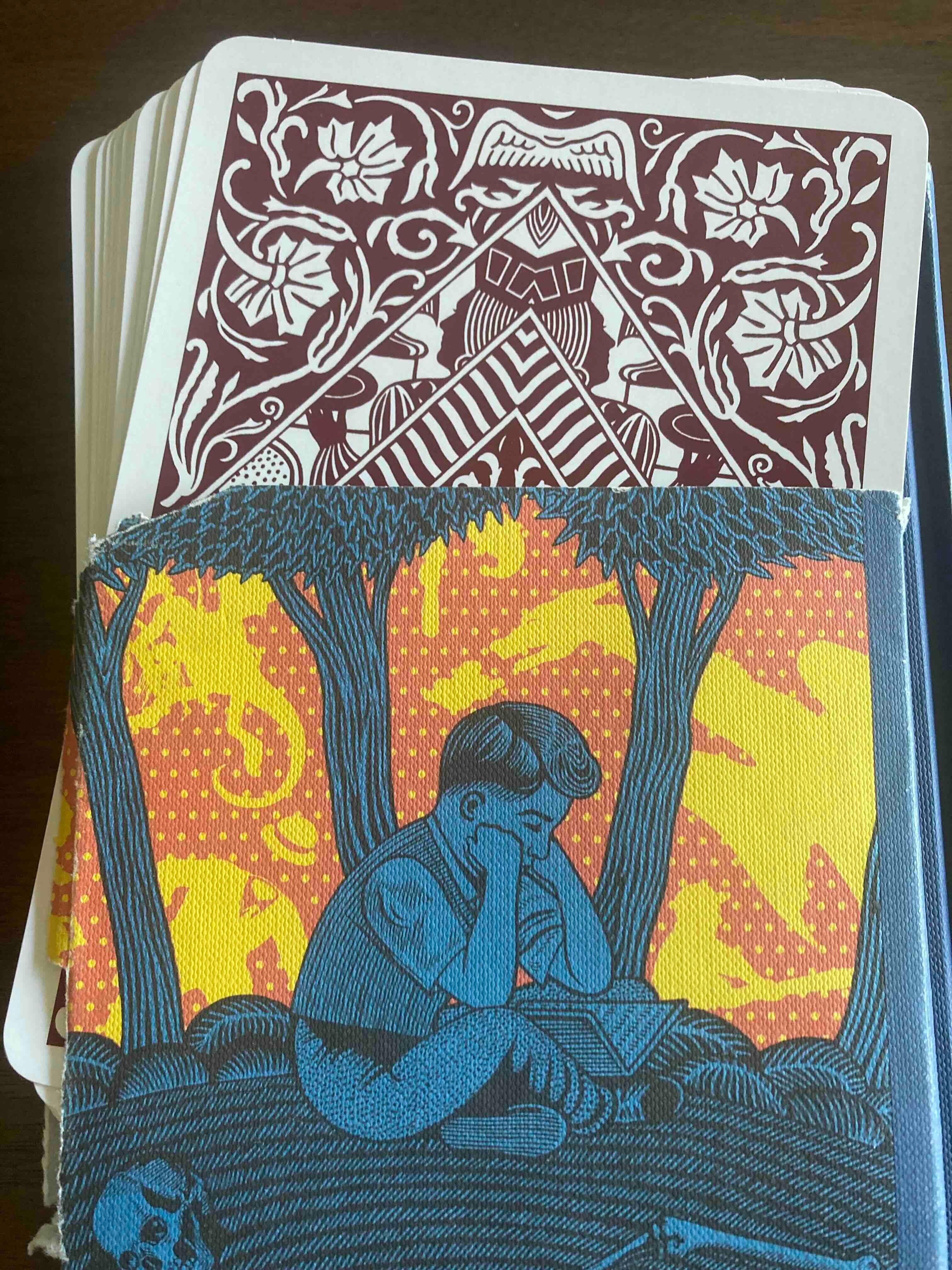
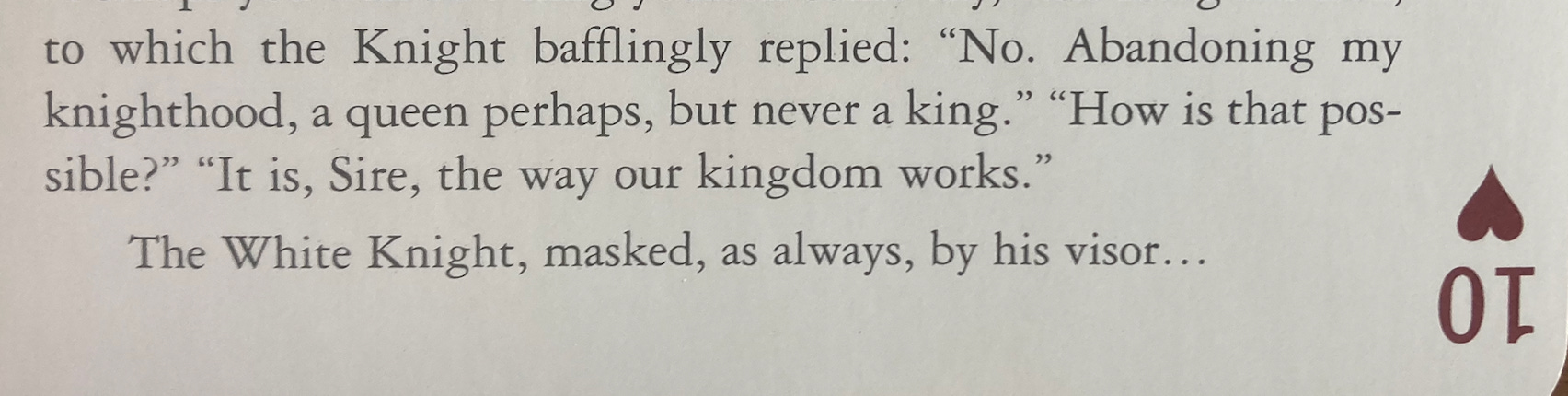
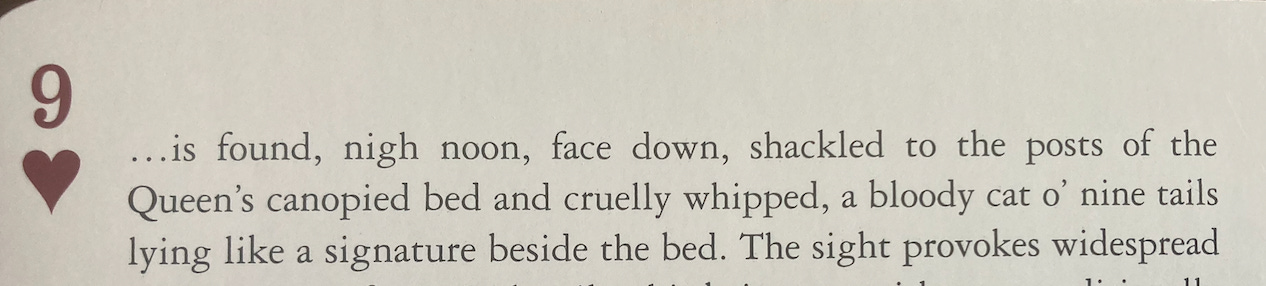
Coover didn’t give up the hypertext ghost once it became clear that the literary revolution he hoped for would not come to pass. Instead, he doubled down in books like A Child Again, a collection of grotesque, weird, violent retellings of childhood tales published by McSweeney’s in 2005. There’s a pocket attached to the back of the book that contains an oversized deck of poker cards which tell a story, “Heart Suit,” a story that can unfold in many combinations (hundreds, thousands, millions?) depending on how

the cards are shuffled, as the last line of each card makes narrative sense no matter which card comes before and after.
The fascination with the untapped potential of hypertext lived on, paradoxically, in print in a way that’s a little less clear. Two books that normally aren’t associated with each other but that both were published in 2000 are exemplars of this: Mark Z. Danielewski’s House of Leaves and Dave Eggers’s A Heartbreaking Work of Staggering Genius. While House of Leaves has entered the canon (not going to say much about it
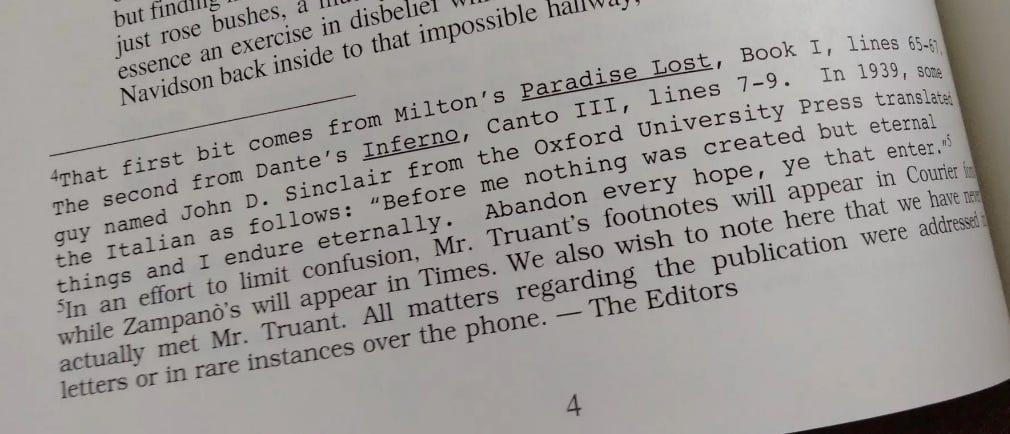
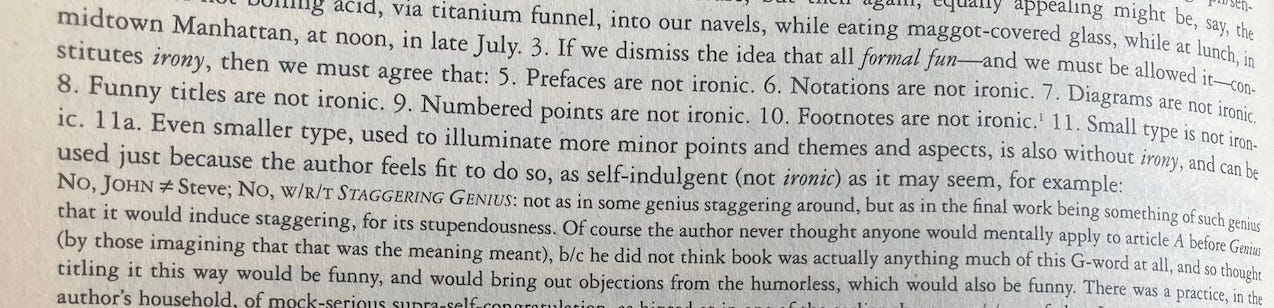
here) as a book that experiments in bold ways with graphic design, page layout, and typography, A Heartbreaking Work has faded, in part because 1) of its humor (funny books/art/film don’t fare as well as “art”!), and 2) its metanarrative dimensions, which are read as ironic and postmodern, qualities which aren’t in favor of late. But there is something of the feeling hypertext in both these books, which demand a tactile (very human) interaction: both books have text boxes / pages printed upside down so you need to flip the book around; both experiment with typefaces and font sizes; both have various narrative framing devices. The books demand involvement and choice, hypertext without the hyperlinks. The Eggers book reduced the font size down to single digits, and in fact addresses the very charges against that will get it dismissed (along with Infinite Jest) as being postmodern: endnotes, self-referentiality, gimmicky (as if “realism” in formatting isn’t a gimmick!) fragmented narration, with all the cynicism and nihilism now associated with it, and none of the fun.
Maybe it’s because of the perceived threat AI poses to creative communities, but there doesn’t seem to be the same sort of desire to experiment with AI’s potential when it comes to narrative that we saw with hypertext. There’s not the equivalent of a Shelley Jackson (Patchwork Girl), Michael Joyce (afternoon), Stuart Moulthrop (Victory Garden), or Robert Coover. Although the experimental works these writers created circulated in relatively small circles, their ways of seeing—like so many avant-garde movements—penetrated deeply into the mainstream in ways that aren’t always obvious. It’s strange to think about how writers like Coover embraced, rather than resisted, the new (at the time) advances in computers and tech in terms of the art of storytelling, detouring larger systems into something fragile and bold and experimental. There seems to be no space to do that today in terms of AI.
Nice work, Nicholas, and thanks for this trip down memory lane. More than mere nostalgia, though. I have been thinking too of how the “ways of seeing”, as you put it, from a small group of hypertexters (and 90s metafictionalists and experimentalists in a broader sense) informed more broadly received directions in fiction since then and considering whether those experiments are still being carried out today (under the radar, as it were). About a year ago I wrote this piece, which was meant to be part of a series (which I might pick back up), below. By coincidence I reposted it yesterday on Twitter, where it got more traction than it did when I first wrote it—there’s a brief nod to The Rachel Condition in there.
https://alvinlu.co/city-god/metafiction-2