Implied Author

One of the weird, amazing dimensions of writing fiction is the unsteady, evolving relationship that tides back and forth between reader and author, a process activated each time the reader picks up the book. Although he is not studied or taught much anymore, Wayne C. Booth really opened up some vast spaces for thinking about this relationship in his 1961 book The Rhetoric of Fiction, where he suggested that in between the flesh-and-blood author and the narrator (persona, speaker) was this liminal zone that included the implied author, an entity that exists as a kind of second

self, the flesh-and-blood author as “an author,” or, in Booth’s words, “the writer who sets himself out with a different air.” In a later essay, “Resurrection of the Implied Author,” he mentions Sylvia Plath and Robert Frost and wonders about the disjunction between their flesh-and-blood selves (FBS’s) and their writerly selves:
They create a realer, truer, more genuine version of their selves than those selves who plagued the world with base behavior. As they sit polishing their works, they wipe out the parts of their selves that they do not like.
Could Booth have foreseen that the exact opposite is true today, when, rather than wiping out parts of themselves they don’t like, authors are encouraged to elevate those exact parts? Although autofiction wasn’t the first to do this, it was caught up in and was in some ways a product of accelerationism, a kind of exhausting everything everywhere all at once-ism. Each week The New Yorker offers yet another example of accelerationism’s refuse with stories that no longer matter or have any real purchase or aliveness and seem to exist simply . . . to exist.
The space that used to be occupied by the implied author has shrunk to the point of practical non-existence. There is nothing implied anymore in the idea of authorship. Implication is a perceived weakness, a failure of nerve, a sensibility that exists mostly in the obscure corners of some liminally minded horror films (The Blackcoat’s Daughter) and fiction (The Night of Turns, Edita Bikker). My own implied author nearly died some while ago and is kept alive in the lucky pockets of space I fell into while writing The Absolution of Robert Acestes Laing, a novel I was in conversation about recently with Matt Kinlin at Heavy Feather Review, a novel that included a cut-out option
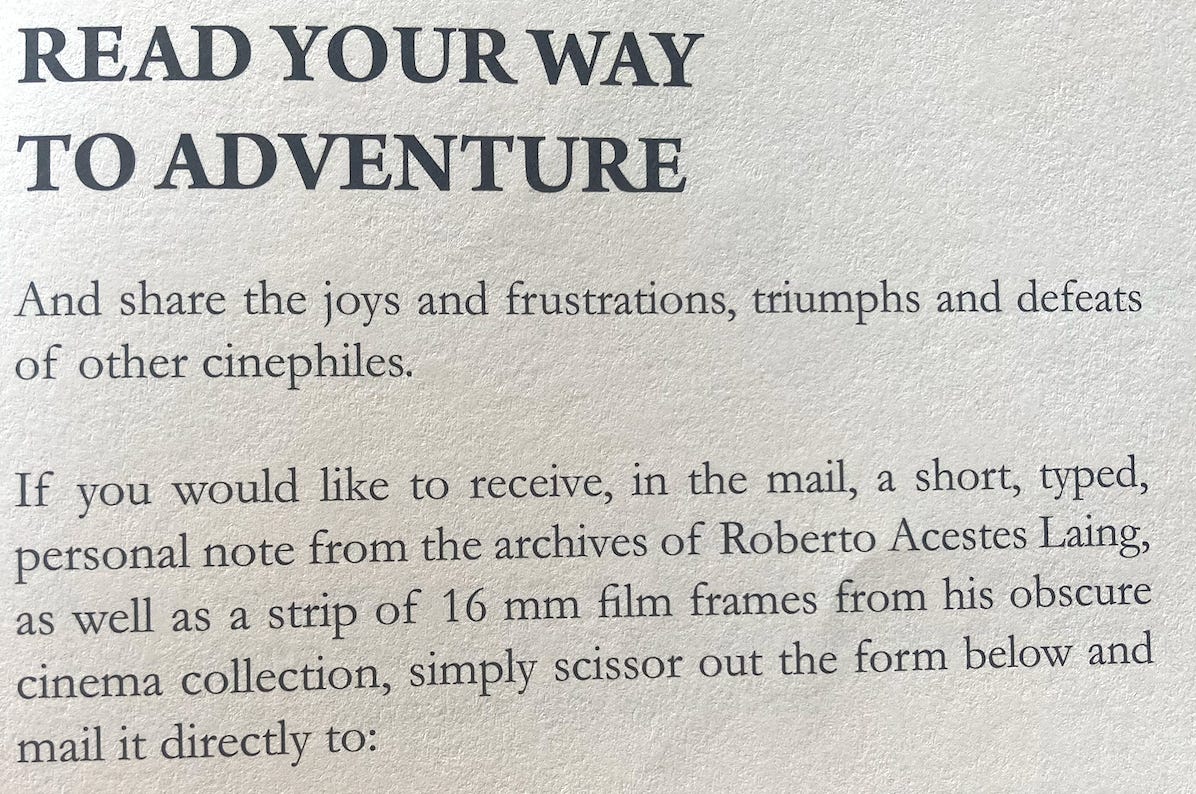
at the back for snail-mail correspondence that always felt like the implied version of me was involved with rather than the FBS version.
The desire to preserve some dimension of the implied author might have something to do with the part of the world I’m from, northwest Ohio. Growing up I didn’t know Ohio was a flyover state. I assumed the flyover states were the other Midwestern states, the boring ones, the ones near the dreadful midpoint of a flight between the coasts. I’m New Romanticizing Ohio not out of any sense of violated state honor or to undo any stereotypes which have accrued to the state in books ranging from Winesburg, Ohio to Hillbilly Elegy (leaving the show The Chair Company out of this).
Was Ohio part of the Midwest, or some other region? The literary theorist Brian McHale published a book, Postmodernist Fiction, in 1987 that spoke to such things. In a section called “Ohio, Oz and other Zones” McHale describes how Ohio figures as a weird, postmodern zone that juxtaposes and superimposes the real and unreal:
The zone sometimes appears where we least expect it. In Ohio, for instance. In the literary and the popular imagination alike, Ohio has long maintained, as they say, a low profile. Its ‘image’ is one of colorlessness and poverty of associations. It is middle-American in every sense: middling in its landscapes and natural phenomena, culturally middling, sociologically middling—not, one would think, raw material for ontological improvisation. And yet . . . a number of postmodernist writers have chosen to improvise on the theme of Ohio.
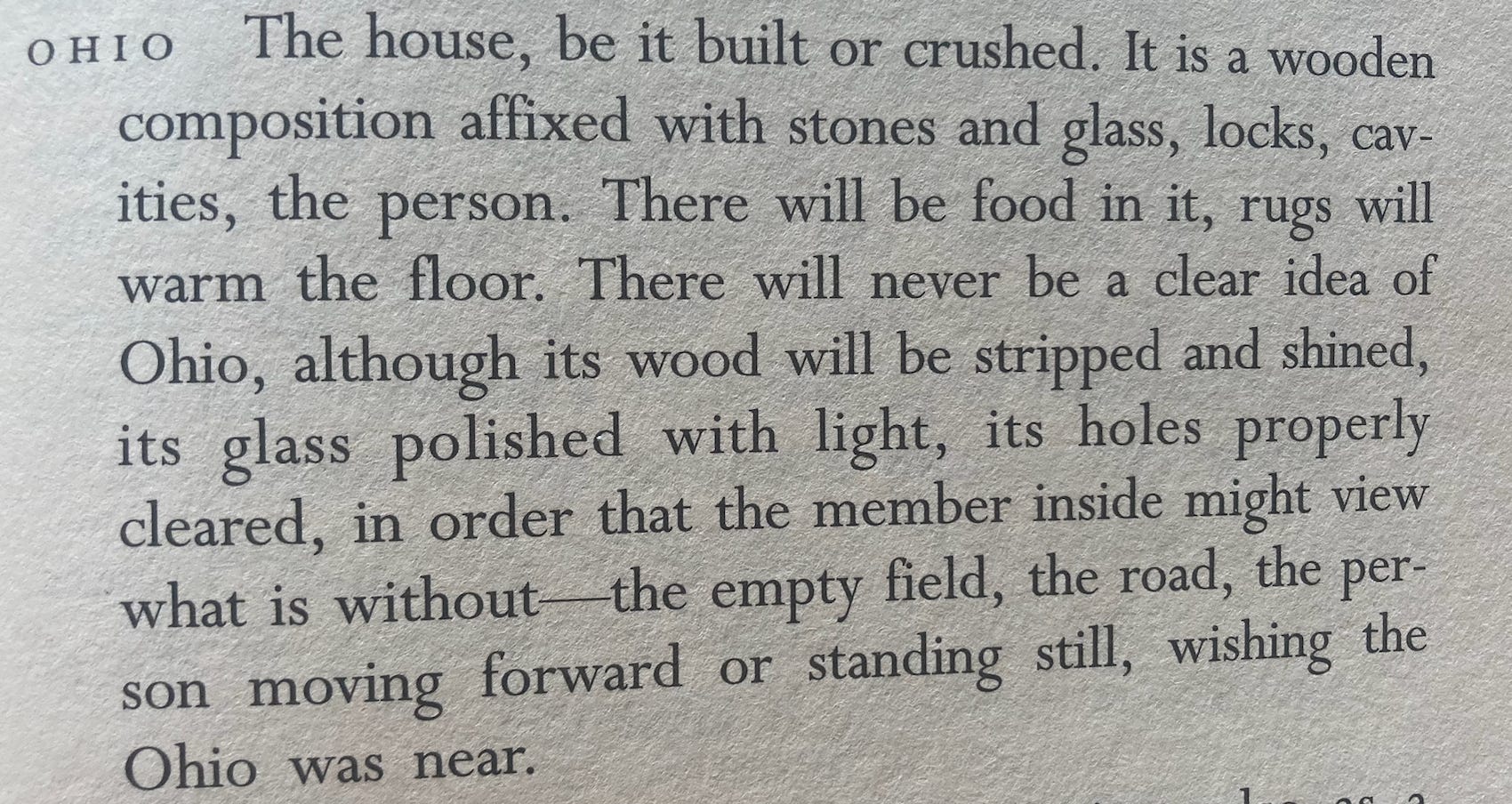
There was something that rang deeply true in McHale’s words, a truth that got at the weird space of Ohio and its wobbly geography, bordered by Kentucky and the sort-of-South on the one end and Michigan and the sort-of North on the other. There is Donald Barthelme’s “Up, Aloft in the Air” (“The rubbery smell of Akron, sister city of Lahore, Pakistan, lay like the flameout of all our hopes”), from his 1964 collection Come Back, Dr. Caligari. And Ben Marcus set his 2002 novel Notable American Women in Ohio, complete with a section entitled “The Ohio Heartless” and lines like “It was a night of pure Ohio silence” and “Jane Marcus occurs in Deep Ohio.” In interviews, Marcus has said that he’s never been to Ohio and that he set the book there because he didn’t know anything about it, that “it was a blank slate for me.”
I’ve gotten in trouble once or twice due to a confusion on the part of readers between the FBS author and the implied author and, in the worst instance of this, I was unable to extricate myself from the thicket of confusions and contradictions that surround this weird membrane. As I recall, I went underground for a year, losing and then regaining confidence that the distinctions that Booth lays out, as blurred and porous as they are, remain vital and worth preserving.